Most self-help books read beautifully. The frameworks are crisp, the case studies tidy, the language confident. Then an ordinary difficult morning arrives — and the framework is nowhere to be found.
Not because it was wrong. Because the gap between the page and the moment is wider than the book admits.
I have spent years testing frameworks against that gap. From a small room in Hamirpur where I lived on a samosa a day, to twenty-six engineering backlogs, to rebuilding a career in a foreign language in Granada — every framework I picked up was eventually tested against something real. Some survived. Most needed a private modification first.
Here are four of those modifications.
1. Implementation Intentions (Atomic Habits) — the lever isn’t language, it’s environment
James Clear’s most quietly powerful idea, borrowed from psychologist Peter Gollwitzer: convert vague aspiration into a specific commitment. I will [behaviour] at [time] in [location].
I first tested it at a hostel in Pushkar, where I had agreed to meditate in the courtyard every morning. The intention held perfectly, week after week. The framework appeared to work.
It worked — but not for the reason I thought.
Months later, alone in a rented room in Granada, the same intention dissolved. Same sentence, same specificity, same person. What had changed was the courtyard. The routine around me. The other people whose presence made sitting still the obvious thing to do.
An implementation intention is not a willpower trick. It is environment design that looks like willpower. When the environment carries the decision, the framework holds. When it doesn’t, the most specific sentence in the world cannot save you.
What survived: the principle — but the lever is environment, not language.
2. Ikigai — it’s a sequence, not a location
The famous four-circle diagram: what you love, what you’re good at, what the world needs, what you can be paid for. Find the diamond where they overlap. Live there.
I spent years in Granada trying to find that diamond. Turning each job over to check it against the circles. The diamond never appeared.
The problem isn’t the concept — it’s the diagram. Four overlapping circles imply ikigai is a place you locate. It isn’t. It’s a sequence you live through. You start with what pays, because survival is not optional. You discover what you’re good at by doing the work, often by accident. You find what you love inside what you’ve become good at. And only from there do you start to perceive what the world actually needs from you.
The Japanese sources are clearer about this than the Western diagram suggests. Ikigai accumulates. It is built, not found.
What survived: the integration is real. The map is wrong. Ikigai is a direction of travel, not a destination.
3. Frankl’s “Why” (Man’s Search for Meaning) — availability, not ambition
Nietzsche’s line runs through Viktor Frankl’s book like a thread: he who has a why to live can bear with almost any how. The self-help reduction is simple — identify a why large enough to make the how bearable.
I didn’t encounter this framework as a strategy. I encountered it as the only thing left standing when everything else collapsed. A friend died suddenly. A diagnosis arrived in the same season. The productivity systems, the routines, the diagrams — they weren’t just inadequate. They were the wrong shape entirely. Grief has no productivity solution.
Frankl’s framework held because it wasn’t asking me to do anything. And what it slowly taught me is that the “why” is not chosen the way you choose a morning routine. It finds you — often through loss, almost always through something you would not have walked toward voluntarily. You cannot manufacture meaning. You can only refuse to look away when it arrives.
What survived: all of it — but as a posture, not a programme.
4. Covey’s Quadrant 2 (7 Habits) — a mirror, not a to-do list
Stephen Covey’s time matrix: urgent/important crises in Quadrant 1, important-but-not-urgent work in Quadrant 2 — the planning, the exercise, the relationships, the learning. The prescription: live in Quadrant 2.
My career in Indian IT was Quadrants 1 and 3, wall to wall. Every Monday opened with escalations from Friday. Always urgent. By Friday there was nothing left for the Quadrant 2 work that would have prevented half the fires in the first place.
What I eventually understood is that Covey’s matrix isn’t really a prescription — everyone already agrees they should do more Q2. It’s a measurement tool. The transformative question is not “should I plan more?” but “where did my hours actually go this week?” Answer that honestly for four consecutive weeks and you discover something uncomfortable: most of your Quadrant 1 was self-inflicted, by a failure to do Quadrant 2 six months earlier.
What survived: the matrix — as diagnostic, not instruction.
The Other Eleven
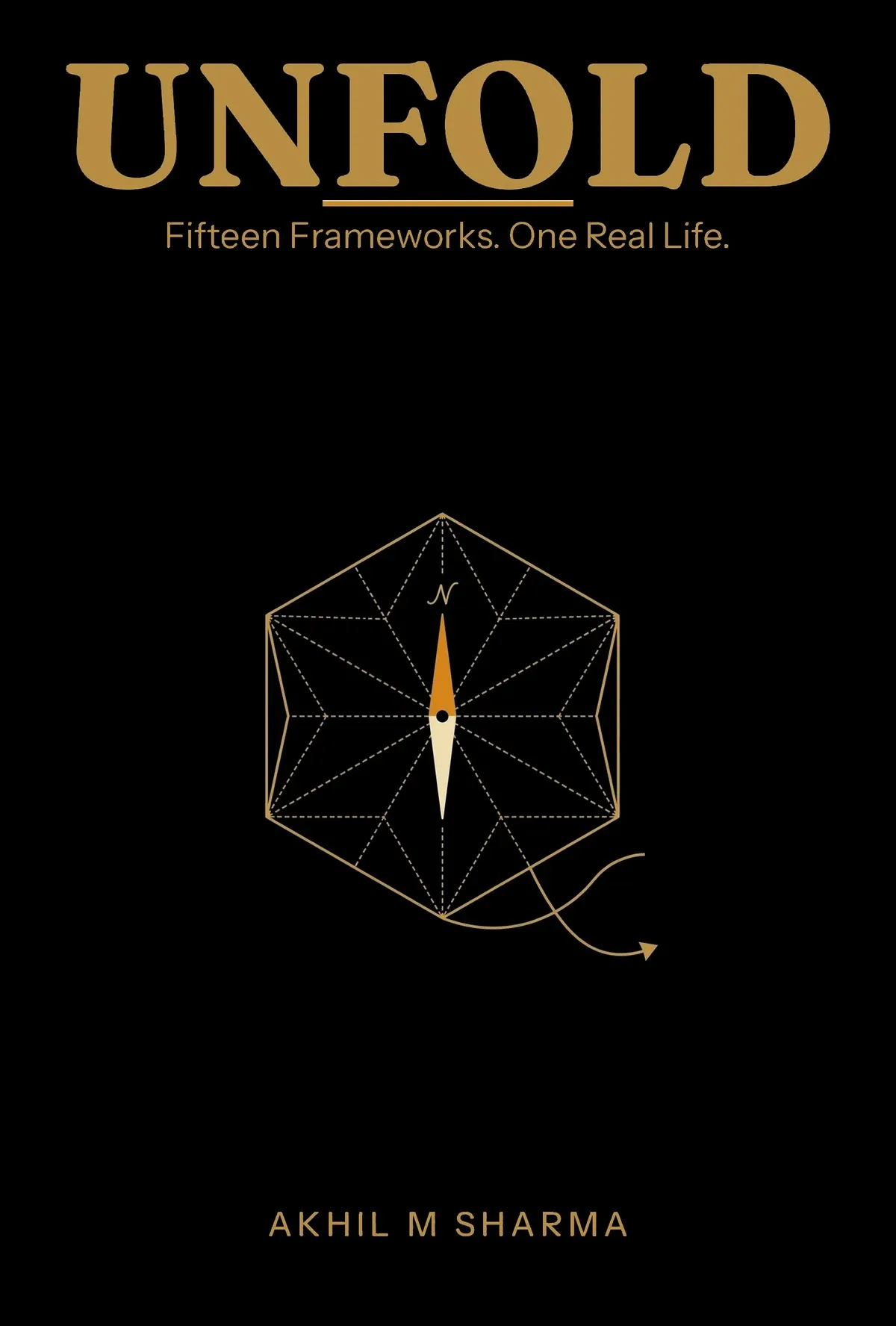
These are four of fifteen frameworks I test in Unfold — against engineering backlogs, a friend’s sudden death, a diagnosis that changed everything, and the slow rebuilding that followed. The other eleven include Ben Horowitz on the question most business writing avoids, habit stacking as it actually behaves when you’re exhausted, and the framework I’ve come to depend on most — one I had read several times before I noticed what it was really saying.
If you’ve noticed the gap between the books on your shelf and your actual Tuesday morning, Unfold was written inside that gap.
Unfold released 16 June 2026 — ebook, paperback, and hardcover.
Want essays like this in your inbox? Subscribe to Margin Notes — frameworks, honestly tested.